

Why Is a Spiral Classifier Still a Smart Choice for Modern Mineral Processing?
2026-02-09
When I first started evaluating classification equipment for mineral processing lines, I realized how often engineers overlook the fundamentals while chasing newer technologies. In many real production scenarios, a well-designed Spiral Classifier continues to deliver reliable performance, stable output, and predictable operating costs. This is exactly where Qingdao EPIC Mining Machinery Co.,Ltd. naturally entered my field of view—not as a loud brand insertion, but as a manufacturer whose equipment aligns closely with actual site needs and long-term plant operation goals.
In mineral processing, classification is not just about separating coarse and fine particles. It is about maintaining downstream stability, reducing unnecessary wear, and keeping the entire circuit running smoothly. From my perspective, a properly selected Spiral Classifier remains one of the most practical tools to achieve that balance.
What Problems Do Operators Commonly Face Without Proper Classification?
Before choosing any classification equipment, I usually start by listing the operational pain points that plant managers mention most often. These issues are not theoretical—they show up daily on production sites.
- Unstable particle size distribution affecting grinding efficiency
- Excessive fine material returning to the mill
- High maintenance costs caused by abrasive slurries
- Poor dewatering performance leading to downstream bottlenecks
In my experience, many of these problems trace back to underperforming or mismatched classification equipment. This is why selecting the right Spiral Classifier becomes a practical decision rather than a purely technical one.
How Does a Spiral Classifier Work in Real Production Conditions?
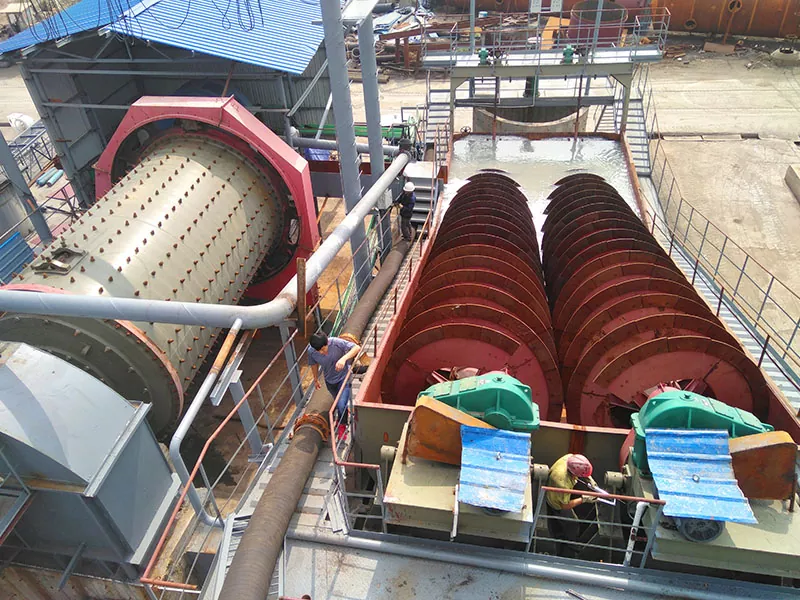
From a practical standpoint, the working principle of a Spiral Classifier is straightforward, which is one of its biggest strengths. Slurry is fed into the inclined tank, where gravity and fluid resistance separate particles by size. Fine particles overflow with the liquid, while coarse particles settle and are conveyed upward by the rotating spiral.
What I appreciate most is how predictable this process is. Operators can visually monitor material behavior, make adjustments quickly, and avoid the black-box effect that sometimes comes with more complex systems. In operations where stability matters more than extreme precision, the Spiral Classifier proves its value repeatedly.
Why Does Equipment Structure Matter More Than Many Buyers Expect?
Over the years, I have learned that classification efficiency is closely tied to mechanical design details. Small differences in structure can lead to noticeable changes in wear resistance, capacity, and energy consumption.
Here are several structural factors I always pay attention to when evaluating a Spiral Classifier:
- Spiral blade design and material selection
- Tank inclination angle and overflow weir structure
- Bearing sealing and lubrication reliability
- Drive system stability under continuous operation
Manufacturers like Qingdao EPIC Mining Machinery Co.,Ltd. tend to focus on these practical engineering details, which directly affects service life and operating consistency in real plants.
Which Applications Benefit Most from a Spiral Classifier?
Based on my observations across different processing lines, a Spiral Classifier fits particularly well in operations where material characteristics are relatively stable and throughput reliability is a priority.
| Application Area | Why a Spiral Classifier Works Well |
|---|---|
| Grinding circuit classification | Maintains stable particle size return to the mill |
| Ore washing lines | Separates fine mud efficiently from coarse material |
| Sand and aggregate processing | Simple structure handles abrasive slurry reliably |
| Pre-concentration systems | Supports downstream separation equipment performance |
In these scenarios, choosing a Spiral Classifier often results in lower maintenance pressure and easier daily operation compared to more complex alternatives.
How Do Spiral Classifiers Compare with Other Classification Options?
I am often asked whether spiral classifiers are outdated compared to hydrocyclones. My answer is usually based on application context rather than trends.
From what I have seen:
- Hydrocyclones offer compact design and high capacity but require stable pressure control
- A Spiral Classifier provides visible, controllable separation with lower system complexity
- Maintenance planning is generally simpler with mechanical classifiers
In plants where water pressure fluctuates or where operators prefer mechanical transparency, the Spiral Classifier remains a dependable solution.
What Should Buyers Consider Before Selecting a Spiral Classifier?
When making a purchasing decision, I recommend focusing on operational compatibility rather than headline specifications alone. A Spiral Classifier should match the material properties, throughput expectations, and maintenance capabilities of the site.
Key considerations include:
- Required classification size range
- Slurry concentration and abrasiveness
- Installation space and elevation layout
- Long-term spare parts availability
Working with an experienced manufacturer such as Qingdao EPIC Mining Machinery Co.,Ltd. helps align equipment selection with these real-world constraints.
Are You Ready to Improve Classification Efficiency in Your Processing Line?
If you are evaluating ways to stabilize your grinding circuit, reduce maintenance headaches, or improve material separation efficiency, a properly engineered Spiral Classifier is worth serious consideration. From my experience, choosing the right equipment partner makes just as much difference as choosing the equipment itself.
If you want to discuss your material conditions or explore suitable solutions for your project, feel free to contact us and leave an inquiry. A practical conversation often leads to better decisions than relying on specifications alone.